Is Moore’s law finally over?
Chipmakers kept Gordon Moore’s promise for six decades. Now the node names have stopped meaning anything, and the physics is fighting back.
This story is also becoming a short film for YouTube. Music only, sources on screen.
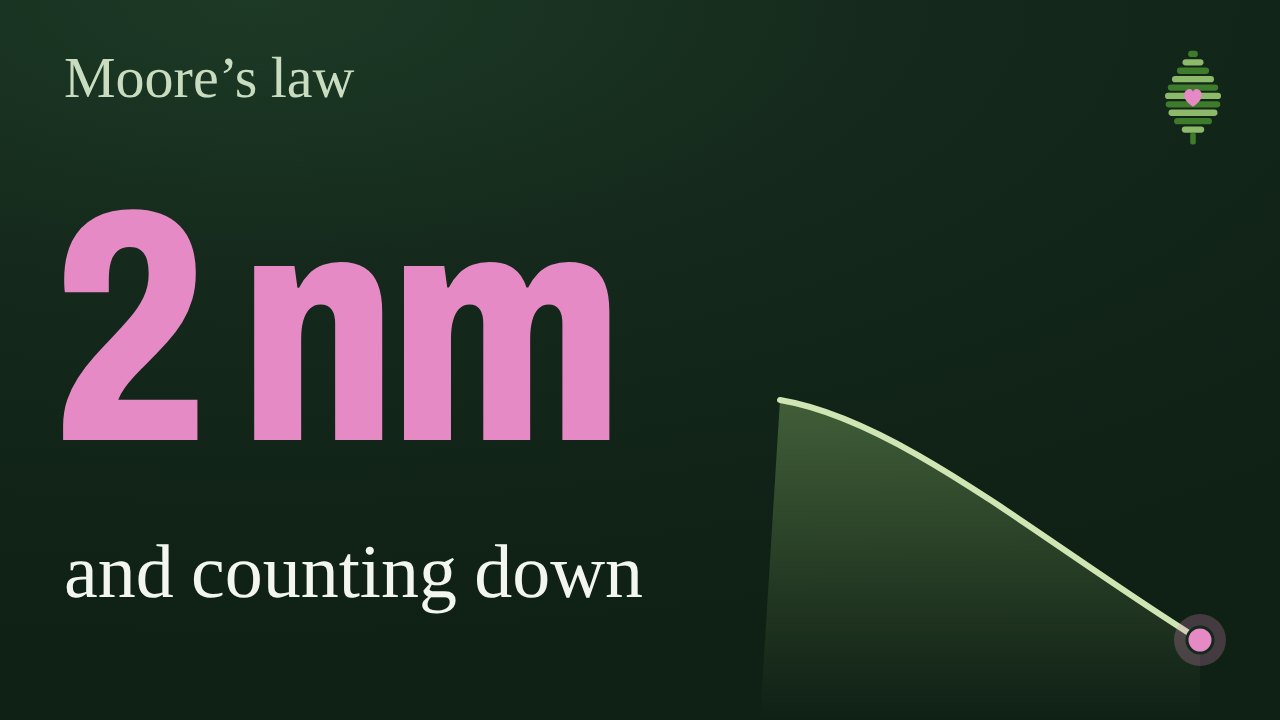
Intel’s 4004 was made on a 10-micrometre process in 1971. TSMC’s newest chips are sold as “2 nanometres”, roughly 5,000 times smaller by name. But since the late 1990s the names have drifted away from any real measurement on the chip.
Each step now costs more and needs stranger tricks: 3D transistors, extreme ultraviolet light, transistors wrapped in gates on every side. The doubling continues, but it is getting slower and much more expensive.
Tap any underlined term for a plain-English explanation.
The story in one chart
Drag to slide, zoom, click any moment.- Milestone
- Turning point
- Drag to slide, scroll the strip to zoom, click a marker
How it works
A chip’s “process node” once measured something real: the length of the transistor’s gate. Smaller transistors are cheaper, faster and use less power, so every new node meant better chips.
Since the late 1990s the names have drifted from any physical dimension. “3 nm” and “2 nm” are now marketing labels for a generation of technology, not the size of anything on the chip. The progress is real; the ruler is not.
The turning points
All 13 moments on the full timeline →- 01April 1965
Moore’s prediction
In Electronics magazine, Gordon Moore predicts the number of components on a chip will double every year. In 1975 he revises it to every two years.
- 022012
FinFET: transistors go 3D
Intel’s 22 nm chips raise the transistor channel into a vertical fin, wrapping the gate around three sides.
- 032019
EUV arrives
Extreme ultraviolet lithography, from Dutch company ASML, the only maker of these machines, enters volume production.
- 04Q4 2025
2 nm and gate-all-around
TSMC starts volume production of N2, its first node with gate-all-around nanosheet transistors, which wrap the gate fully around stacked channels.
“2 nm”N2
Go deeper
More stories
All 19 stories → Film coming soonData story 07 · Chips and hardwareThe memory wall: AI’s hidden bottleneckProcessors got fast; memory didn’t keep up. The fix is a stack of chips welded beside the GPU, and only three companies can make it.
 Film coming soonData story 08 · Chips and hardwareFrom ENIAC to your pocket: the digital computerThe machines that filled rooms with vacuum tubes, the transistor that replaced them, and the chips that put a supercomputer in every pocket.
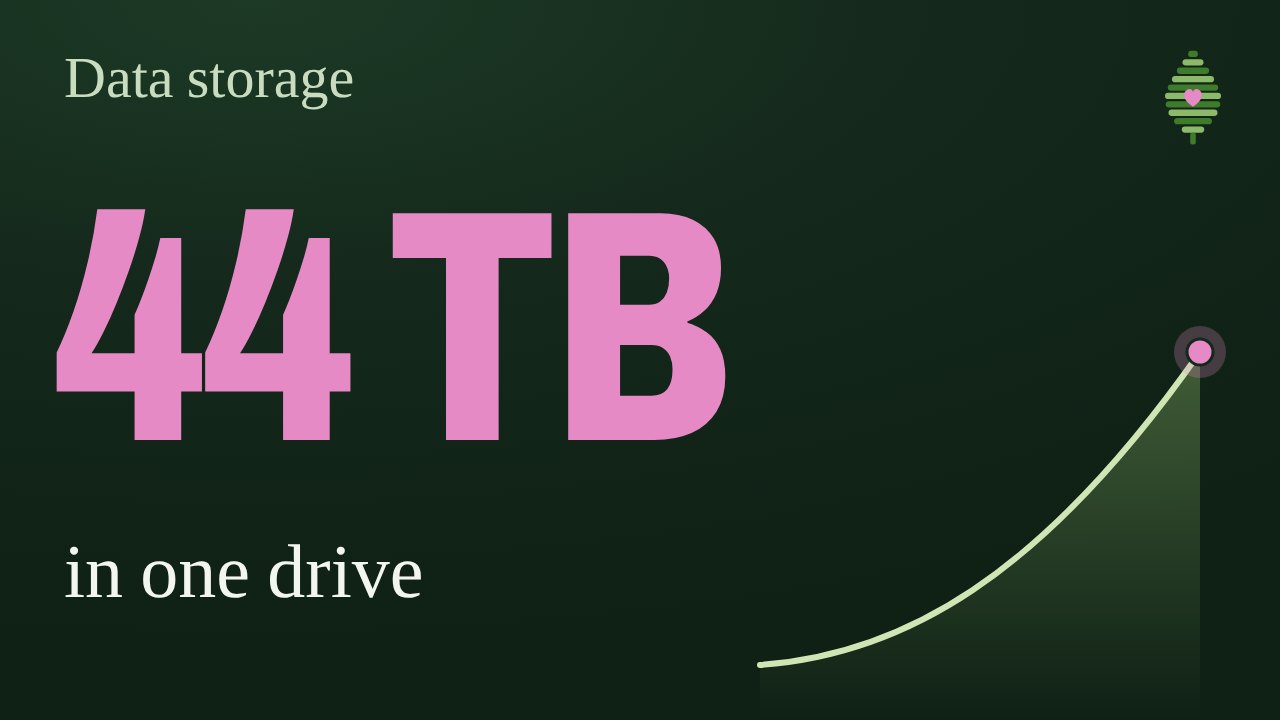 Film coming soonData story 16 · Chips and hardwareWhere the world’s data livesTape, spinning disks and flash chips: how storage grew 12 million times in 70 years, and how AI is pushing it further.