Artificial intelligence: a timeline
From a paper model of a neuron to machines that write, code and reason. Eight decades of breakthroughs, winters and comebacks.
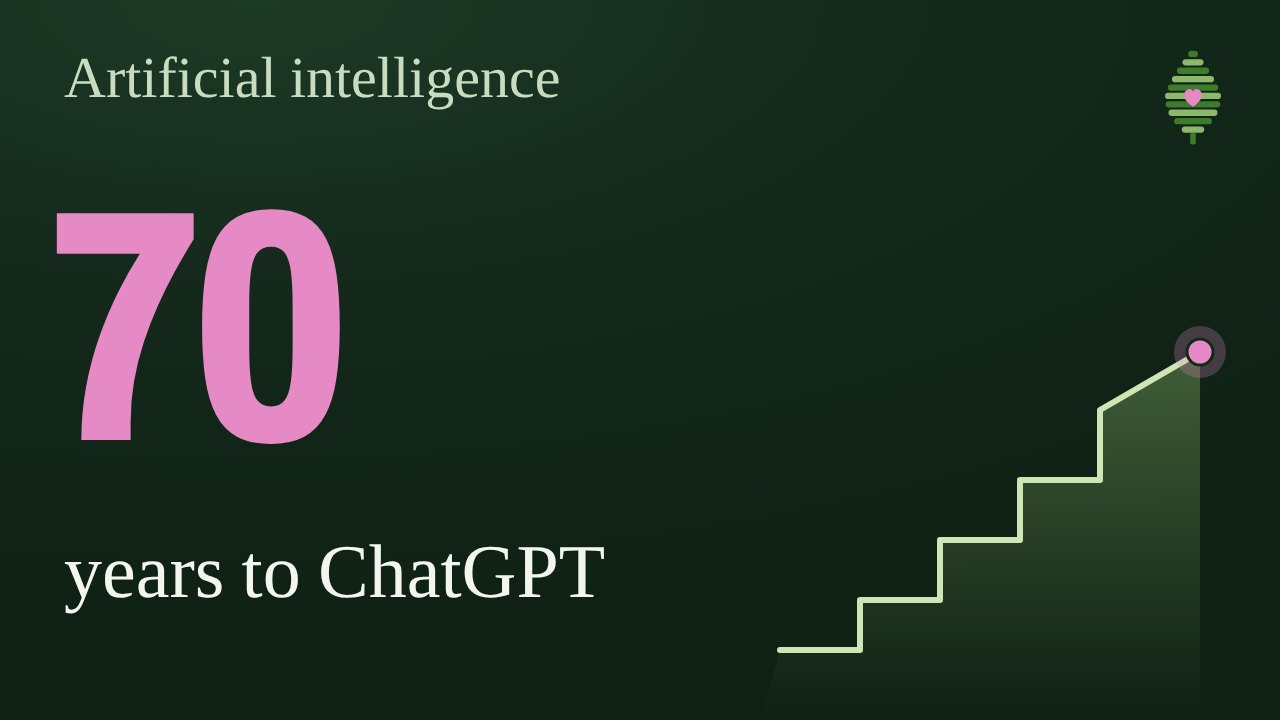 Read the story · film coming soonSeventy years of AI: two winters and a gold rush→
- Milestone
- Turning point
- Setback
- Drag to slide, scroll the strip to zoom, click a marker
- 19431943
A neuron on paper
Warren McCulloch and Walter Pitts describe a simple mathematical model of a neuron, the seed of every neural network since.
- 19501950
Can machines think?
Alan Turing publishes “Computing Machinery and Intelligence” and proposes the imitation game, now known as the Turing test.
- 1956Summer 1956
AI gets its name
The Dartmouth workshop, proposed by John McCarthy and others, launches “artificial intelligence” as a field of research.
- 19581958
The perceptron
Frank Rosenblatt’s perceptron learns to recognise simple patterns, and newspapers predict thinking machines within years.
- 19661966
ELIZA talks back
Joseph Weizenbaum’s ELIZA mimics a psychotherapist with simple pattern-matching. People confide in it anyway.
- 19691969
The limits of perceptrons
Marvin Minsky and Seymour Papert show what single-layer networks cannot do. Interest in neural networks fades for a decade.
- 19731973Winter
The first AI winter
The UK’s Lighthill report criticises AI’s broken promises. Funding is cut on both sides of the Atlantic.
- 19801980s
Expert systems boom
Rule-based “expert systems” such as XCON at Digital Equipment Corporation go into business use, and AI money returns.
- 19861986
Backpropagation
David Rumelhart, Geoffrey Hinton and Ronald Williams popularise backpropagation, the method still used to train neural networks.
- 19871987Winter
The second winter
The market for specialised AI hardware collapses and expert systems prove brittle. AI becomes an unfashionable word again.
- 1997May 1997
Deep Blue beats Kasparov
IBM’s chess computer defeats the world champion Garry Kasparov in a six-game match.
- 19981998
Reading handwriting
Yann LeCun’s LeNet-5, a convolutional network, reads handwritten digits well enough for banks to process cheques.
- 20092009
ImageNet
Fei-Fei Li’s team releases ImageNet, millions of labelled images that become the proving ground for computer vision.
- 20112011
Watson wins Jeopardy!
IBM Watson beats two human champions on the US quiz show.
- 20122012
AlexNet and the GPU moment
A deep network trained on two Nvidia gaming GPUs wins the ImageNet contest by a wide margin. The deep-learning era begins.
2gaming GPUs did the training - 20142014
Machines that generate
Ian Goodfellow introduces generative adversarial networks (GANs), two networks that compete to create realistic images.
- 2016March 2016
AlphaGo beats Lee Sedol
DeepMind’s AlphaGo wins 4–1 against one of the world’s best Go players, a feat many expected to be a decade away.
- 2017June 2017
Attention is all you need
Google researchers publish the Transformer architecture. Nearly every large language model since is built on it.
- 20182018
GPT-1 and BERT
OpenAI and Google show that Transformers pre-trained on huge amounts of text can be adapted to many language tasks.
- 20202020
GPT-3 and AlphaFold 2
GPT-3 arrives with 175 billion parameters. DeepMind’s AlphaFold 2 predicts protein structures with near-experimental accuracy.
175bnparameters in GPT-3 - 202230 Nov 2022
ChatGPT
OpenAI releases ChatGPT to the public. Generative AI becomes a mass-market product almost overnight.
- 2023March 2023
GPT-4 and the model race
Multimodal models that pass professional exams arrive. Big tech races to build bigger clusters of GPUs.
- 2024Oct 2024
AI wins Nobel prizes
Geoffrey Hinton and John Hopfield share the physics prize for neural networks. Demis Hassabis and John Jumper share chemistry for AlphaFold, with David Baker.
- 2024Sept 2024
Models that “think”
Reasoning models such as OpenAI’s o1 spend extra computing time working through a problem before answering, so running a model gets more expensive.
- 2025Jan 2025
The DeepSeek shock
China’s DeepSeek-R1 matches leading reasoning models at a fraction of the reported cost. Nvidia loses close to US$600 billion in market value in a day.
- 20262026
Inference takes over
Deloitte forecasts that running models (inference) will be about two-thirds of all AI compute in 2026, up from a third in 2023.
2/3of AI compute is inference (forecast)
- Computing Machinery and Intelligence (Wikipedia)
- Vaswani et al., “Attention Is All You Need” (2017)
- The Nobel Prize in Physics 2024
- The Nobel Prize in Chemistry 2024
- Deloitte, TMT Predictions 2026: compute power and AI
Dates for early events are widely documented; recent figures are labelled with their source, and forecasts are marked as forecasts.