Data storage: a timeline
From a hard drive the size of two fridges holding 3.75 MB to a single drive holding 44 TB, and the flash chips that replaced spinning disks in your pocket.
 Read the story · film coming soonWhere the world’s data lives→
- Milestone
- Turning point
- Drag to slide, scroll the strip to zoom, click a marker
Every photo, model and message has to live somewhere. Two technologies do most of the work: hard drives, which store data magnetically on spinning platters and are still the cheapest way to keep huge amounts, and flash, chips with no moving parts that are faster and now fill phones, laptops and AI servers.
The line shows the largest hard drive available, on a log scale. AI’s appetite for data is pushing both technologies harder: hard-drive makers are using lasers to heat the disk as they write (HAMR) to reach 100 TB by the end of the decade.
- 19511951
Magnetic tape
The UNIVAC I uses the UNISERVO, the first tape drive for a commercial computer, replacing stacks of punched cards.
- 1956Sept 1956
The first hard drive
IBM’s 350 RAMAC stores 3.75 MB on fifty 24-inch platters. It weighs about a tonne and is leased, not sold.
3.75 MB - 19711971
The floppy disk
IBM ships the 8-inch floppy disk, first used to load software into its mainframes.
- 19801980
A drive for the PC
Seagate’s ST-506 squeezes 5 MB into a 5.25-inch drive, the size that shapes the personal computer.
- 19821982
The compact disc
Sony and Philips launch the CD. As the CD-ROM from 1985, it carries software and encyclopedias.
- 19871984–87
Flash memory
At Toshiba, Fujio Masuoka invents flash memory, first NOR (1984) then NAND (1987), which stores data on chips with no moving parts.
- 19911991
A gigabyte
IBM’s 0663 Corsair holds 1 GB in a 3.5-inch drive.
- 20002000
The USB stick
The first USB flash drives appear, holding 8 MB. The floppy disk’s days are numbered.
- 20072007
A terabyte
Hitachi ships the first 1 TB hard drive.
1 TB
- 2013Aug 2013
3D NAND
Samsung stacks flash cells vertically in layers. Modern chips stack hundreds of layers, making large, cheap SSDs possible.
- 2013Nov 2013
Helium drives
HGST fills a sealed hard drive with helium to fit more platters, reaching 6 TB.
- 2024Jan 2024
Heat-assisted recording
Seagate launches 30 TB drives on its Mozaic 3+ platform, using a tiny laser to heat each spot on the disk as it writes (HAMR).
- 2026March 2026
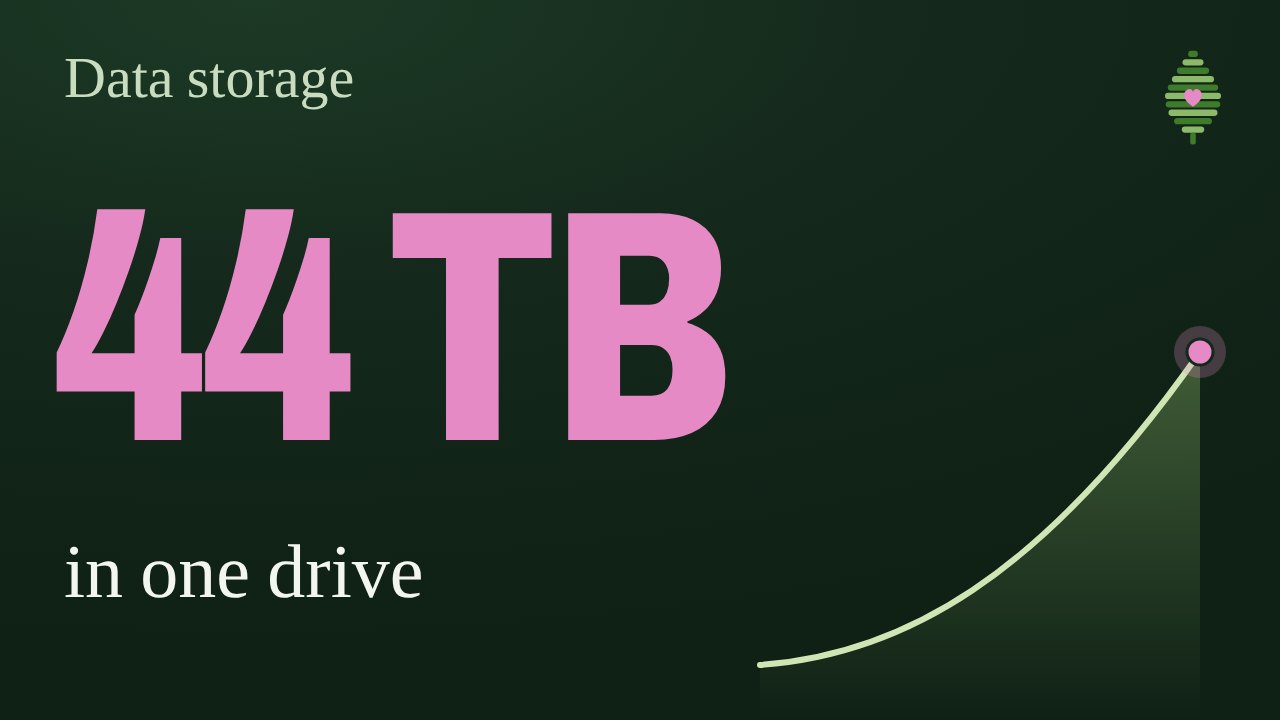
44 TB
Seagate’s Mozaic 4+ HAMR drives reach 44 TB. Western Digital ships 40 TB drives and plans 100 TB HAMR drives by 2029.
- Seagate, Mozaic 4+ press release (March 2026)
- StorageReview, WD 40TB UltraSMR starts shipping (Aug 2026)
- Tom’s Hardware, WD plans 100TB HAMR drives by 2029
- IBM, the IBM 350 RAMAC disk file
- History of hard disk drives (Wikipedia)
Dates for early events are widely documented; recent figures are labelled with their source, and forecasts are marked as forecasts.